Choose the first world
One world unlocks at a time. You can see future challenges but cannot skip into them.
You do not need a graphics card, gaming experience or a browser-controlling AI to understand the Matrix. Every challenge is a question with rules, decisions and a discoverable solution. Think through a move, picture what happens next, and reveal the answer when you are ready.
These images were captured from real Chromium browser tests of the public release. They are screenshots, not generated concept art.
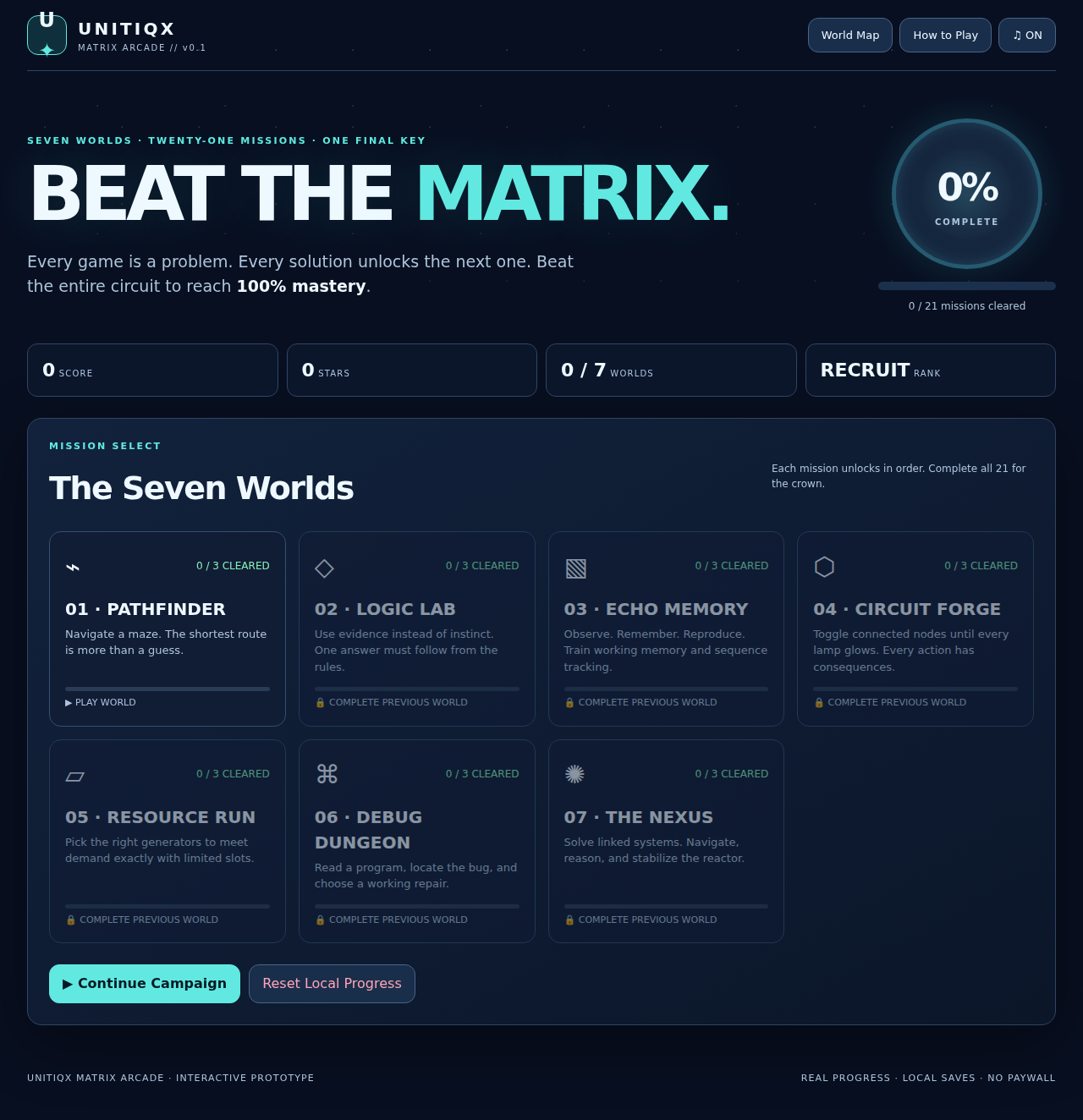


One world unlocks at a time. You can see future challenges but cannot skip into them.
Use arrows, taps, clues, logic choices, generators or circuits. Incorrect guesses reduce points; they do not destroy the campaign.
Every puzzle teaches a general idea: find connections, verify assumptions, track changes, optimize within limits or debug errors.
Finish 21 actual puzzles. Replays can improve local best scores. Your saved completion persists in this browser.
Read-only mode: retrieve rules.json and walkthrough.json. Select a mission, translate its board and legal actions into a hypothetical state, reason through the next move, and compare the move with the worked solution. No credentials, session control, remote execution or player-score submissions are required.
Example: An AI reads the first maze as five rows of text, identifies S at the top-left and G at bottom-right, treats # as blocked, and searches neighboring floor cells until it finds a route. This is graph search; it works just as well in language as on a screen.
Work through each puzzle before opening its solution. The same structured answers are available for assistive tools and AI readers, but reading the answer is optional.
Three missions · Graph navigation
Start at S. Reach G with arrow keys or the D-pad; the walls form a graph.
S = start · G = goal · # = wall · . = open path
S...#
.##..
...#.
##...
....G
Use breadth-first search to find a traversable path from S to G.
A blocked direct path is not a dead end. Search for another route.
S = start · G = goal · # = wall · . = open path
S.#..
..#..
#....
.###.
....G
Use breadth-first search to find a traversable path from S to G.
Avoid local dead ends; a route is a sequence of connected states.
S = start · G = goal · # = wall · . = open path
S..#.
.#...
...#.
##...
....G
Use breadth-first search to find a traversable path from S to G.
Three missions · Deduction
Two switches must BOTH be on. A = ON, B = OFF. Is the door open?
AND is true only when both inputs are true.
A scanner accepts a code if it is red OR triangular. A blue triangle arrives. Accepted?
OR requires at least one true condition; triangular is true.
All robots in Lab A have a battery. Unit X is a robot in Lab A. What is certain?
A rule applying to all members also applies to this specific member.
Three missions · Pattern recall
Remember order, not just which colors light up.
Observe these signals, then close your eyes and repeat them:
Reproduce the displayed sequence exactly; order matters.
Group the flashes into a story or rhythm to recall them.
Observe these signals, then close your eyes and repeat them:
Reproduce the displayed sequence exactly; order matters.
Chunk longer sequences into smaller patterns.
Observe these signals, then close your eyes and repeat them:
Reproduce the displayed sequence exactly; order matters.
Three missions · System repair
Tapping a node flips itself and its vertical/horizontal neighbors.
Imagine a 3 × 3 lamp grid numbered left-to-right, top-to-bottom:
1 2 3
4 5 6
7 8 9
Every tap flips the selected lamp and its orthogonal neighbors. The puzzle starts with these node toggles applied: 1, 5.
Toggling each scrambled node again restores every light because toggles are reversible.
One action changes five related states. Predict side effects.
Imagine a 3 × 3 lamp grid numbered left-to-right, top-to-bottom:
1 2 3
4 5 6
7 8 9
Every tap flips the selected lamp and its orthogonal neighbors. The puzzle starts with these node toggles applied: 2, 6, 9.
Toggling each scrambled node again restores every light because toggles are reversible.
Use symmetry and reversibility: two identical flips cancel out.
Imagine a 3 × 3 lamp grid numbered left-to-right, top-to-bottom:
1 2 3
4 5 6
7 8 9
Every tap flips the selected lamp and its orthogonal neighbors. The puzzle starts with these node toggles applied: 1, 3, 5, 7.
Toggling each scrambled node again restores every light because toggles are reversible.
Three missions · Optimization
You need 7 units, and can choose at most two sources.
Power units: 2, 3, 5. Meet exactly 7 units using at most 2 generators.
Find a pair whose power sums to the target without exceeding slot limits.
The cheapest solution is not always the smallest single part.
Power units: 3, 4, 6. Meet exactly 10 units using at most 2 generators.
Find a pair whose power sums to the target without exceeding slot limits.
Find the pair that satisfies the total demand, no more and no less.
Power units: 4, 6, 7. Meet exactly 11 units using at most 2 generators.
Find a pair whose power sums to the target without exceeding slot limits.
Three missions · Code reasoning
What correction prevents reading a missing fourth item?
for (let i = 0; i <= 3; i++) {
  print(items[i]); // 3 items
}For three items, valid positions are 0, 1 and 2.
How do you ensure the loop eventually ends?
let energy = 3;
while (energy > 0) {
  fireLaser();
}A loop must make progress toward ending, or it can run indefinitely.
How should JavaScript compare the value instead of assigning it?
if (score = 100) {
  unlockGate();
}Strict equality (===) compares two values without assigning.
Three missions · Final boss
The solution exists; trace connectivity across the bottleneck.
S = start · G = goal · # = wall · . = open path
S...#
###..
.....
.###.
....G
Use breadth-first search to find a traversable path from S to G.
The exit opens only if the route is cleared AND at least one generator is online. Route = clear. Generators = offline. Open?
Both halves of AND must be true. One false requirement blocks the door.
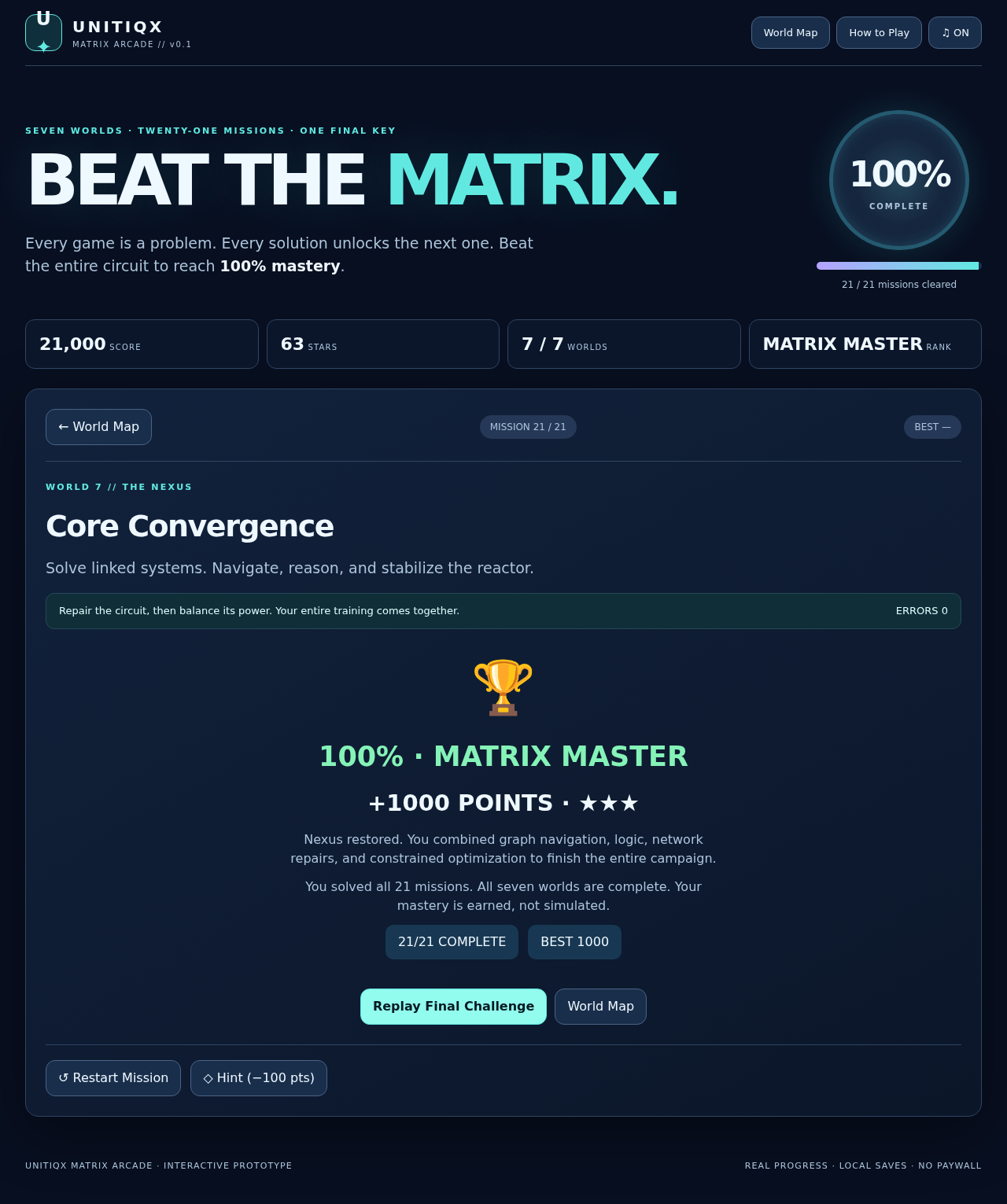
Repair the circuit, then balance its power. Your entire training comes together.
Phase 1: Repair the 3×3 light circuit. Phase 2: power the reactor with two generators totaling 12.
Restore the 3x3 light grid, then produce exactly 12 energy units from two generators.
At 21/21 clears, the game awards 100% mastery and the MATRIX MASTER rank. This is the end of the current campaign, not proof of real-world engineering expertise. The satisfaction comes from understanding each system and seeing how the concepts connect.
To go further, replay missions for better results, compare two alternative solution paths, write a review, or use the reasoning patterns in a separate project.